The cluster module
Optimal Number of Clusters Searcher
- class NClusterSearch(estimator, method='elbow', *, min_clusters=1, max_clusters=10, step=1, random_state=123, n_jobs=1, verbose=False)
NClusterSearch
A helper class to identify the optimal number of clusters for clustering algorithms.
- __init__(estimator, method='elbow', *, min_clusters=1, max_clusters=10, step=1, random_state=123, verbose=False)
- Parameters:
estimator (object) – The clustering algorithm for which you want to find the optimal number of clusters. Also can be a Pipeline object with the last step being a clustering algorithm. Supported estimators: KMeans, KMedoids, KModes, KPrototypes.
method (str) – The method used to determine the optimal number of clusters. Accepted values: ‘elbow’, ‘silhouette’. Default: “elbow”.
min_clusters (int) – The minimum number of clusters to consider. Default: 1.
max_clusters (int) – The maximum number of clusters to consider. Default: 10.
step (int) – The step size for increasing the number of clusters during the search. Default: 1.
random_state (int) – Random seed for reproducibility. Default: 123.
n_jobs (int) – The number of jobs to run in parallel for the search. If -1, then the number of jobs is set to the number of CPU cores. Default: 1.
verbose (bool) – If True, the process will print details as it proceeds. Default: False.
- fit(X, **kwargs)
Fits the estimator with the data over a range of cluster numbers.
- Parameters:
X (array-like) – The data to determine the optimal number of clusters for.
**kwargs –
Additional keyword arguments to be passed to the estimator’s fit method.
- Returns:
Returns an instance of NClusterSearch().
- Return type:
object
- plot(ax=None)
Plots the results of the selected method (either ‘elbow’ or ‘silhouette’) to visualize the optimal cluster number.
- Parameters:
ax (object) – Axis on which to draw the plot. If None, a new figure and axis will be created. Default: None.
- predict(X, **kwargs)
Predicts the closest cluster for each sample in X using the best_estimator_.
- Parameters:
X (array-like) – New data to predict cluster labels.
**kwargs –
Additional keyword arguments to be passed to the estimator’s predict method.
- Returns:
Index of the cluster each sample belongs to.
- Return type:
array
- best_estimator_
- Returns the estimator with the optimal number of clusters.
- labels_
- Returns the labels of each point for the best estimator.
Examples:
Example 1: Using the elbow method with KMeans
from sklearn.cluster import KMeans
from sklearn.datasets import load_iris
from estyp.cluster import NClusterSearch

data = load_iris().data
new_data = load_iris().data[:10]
searcher = NClusterSearch(estimator=KMeans(), method='elbow')
searcher.fit(data)

labels = searcher.labels_
predicted_labels = searcher.predict(new_data)
optimal_model = searcher.best_estimator_
optimal_clusters = searcher.optimal_clusters_

searcher.plot()

Example 2: Using KModes with custom arguments
from kmodes.kmodes import KModes
import pandas as pd
import numpy as np

np.random.seed(2023)
data = pd.DataFrame(np.random.randint(0, 10, size=(100, 4))).apply(lambda x: x.astype('object'))

kmodes = KModes(init='Huang', n_init=5)
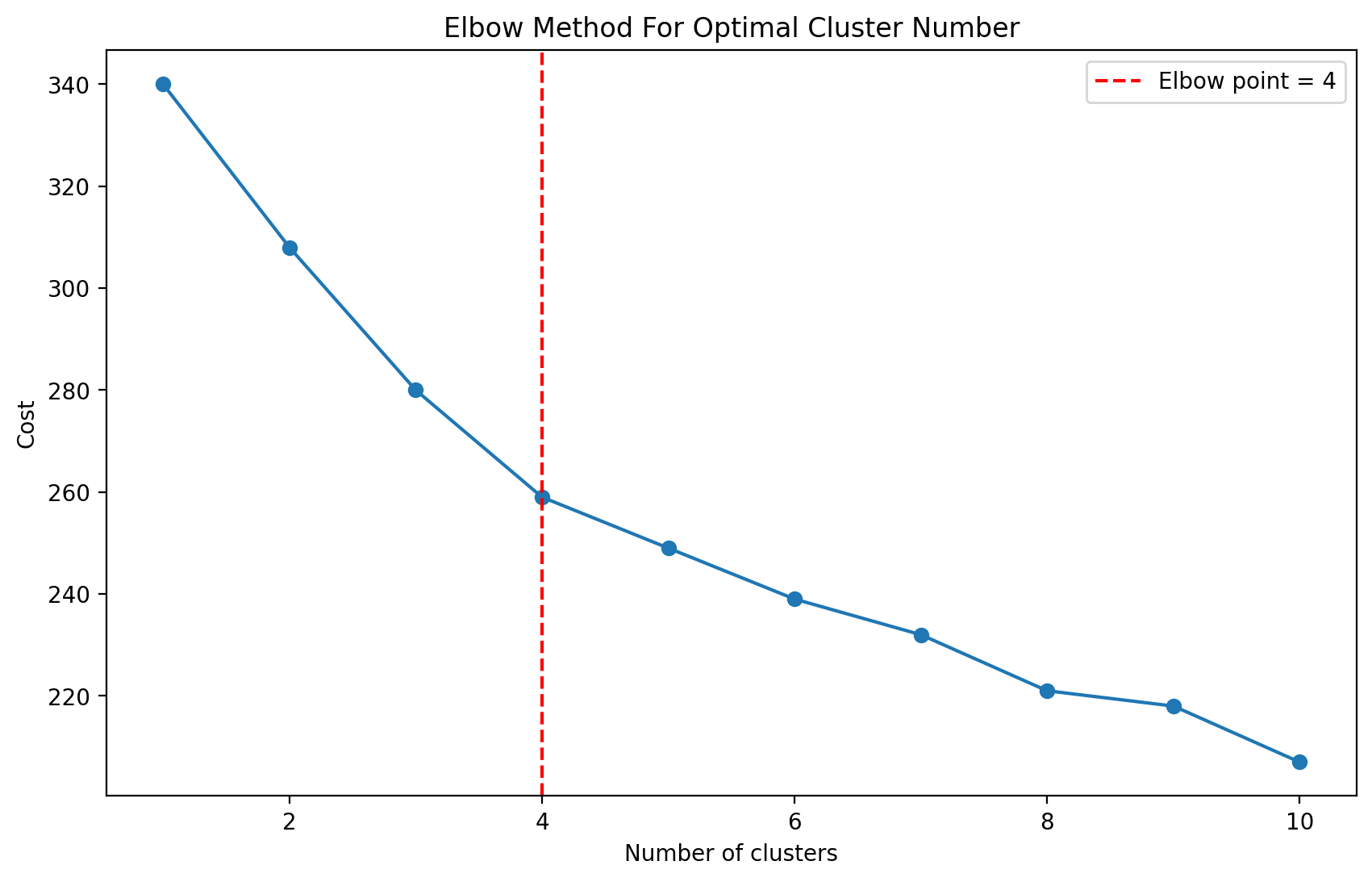
searcher = NClusterSearch(estimator=kmodes, method='elbow')
searcher.fit(data)
searcher.plot()
Example 3: Using the silhouette method with KMedoids
from sklearn.datasets import load_iris
from sklearn_extra.cluster import KMedoids

data = load_iris().data

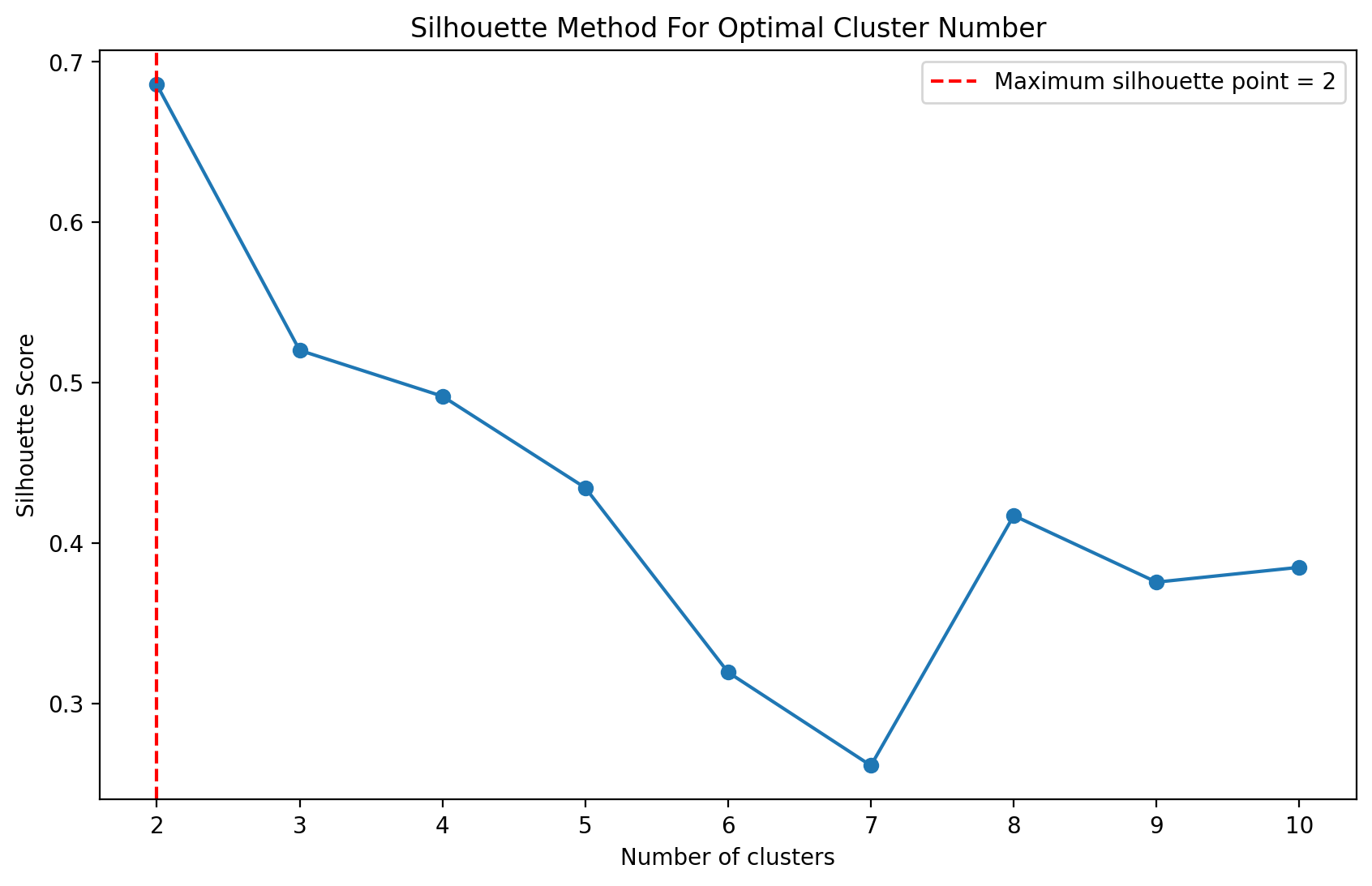
searcher = NClusterSearch(estimator=KMedoids(), method='silhouette')
searcher.fit(data)
searcher.plot()
Example 4: Using the silhouette method with KPrototypes
import pandas as pd
import numpy as np
from kmodes.kprototypes import KPrototypes

np.random.seed(2023)
data = pd.DataFrame(np.random.randint(0, 10, size=(100, 4))).apply(lambda x: x.astype('object'))
data["new"] = np.random.randint(0, 10, size=(100, 1))

searcher = NClusterSearch(estimator=KPrototypes(), method='silhouette', verbose=True)
searcher.fit(data, categorical=[0, 1, 2, 3])
searcher.plot()
Calculating silhouette scores...
Creating distance matrix...

Example 5: Using the silhouette method with KPrototypes and custom alpha for distance calculation
import pandas as pd
import numpy as np
from kmodes.kprototypes import KPrototypes

np.random.seed(2023)
data = pd.DataFrame(np.random.randint(0, 10, size=(100, 4))).apply(lambda x: x.astype('object'))
data["new"] = np.random.randint(0, 10, size=(100, 1))

searcher = NClusterSearch(estimator=KPrototypes(), method='silhouette')
searcher.fit(data, categorical=[0, 1, 2, 3], alpha=0.1)
searcher.plot()

Example 6: Using the elbow method with a pipeline of with standard scaler and Kprototypes and parallel processing.
import pandas as pd
from sklearn.datasets import load_iris
from sklearn.preprocessing import StandardScaler
from sklearn.compose import make_column_transformer
from sklearn.pipeline import make_pipeline
from kmodes.kprototypes import KPrototypes
from estyp.cluster import NClusterSearch

X, y = load_iris(return_X_y=True)
df = pd.DataFrame(X)
df.columns = df.columns.astype(str)
df["y"] = y

transformer = make_column_transformer(
    (StandardScaler(), [0, 1, 2, 3]),
    remainder='passthrough'
)
kproto = KPrototypes(init='Huang')
model = make_pipeline(transformer, kproto)

searcher = NClusterSearch(
    estimator    = model,
    method       = "elbow",
    min_clusters = 1,
    max_clusters = 10,
    n_jobs       = -1
)
searcher.fit(df, kprototypes__categorical = [4])
searcher.plot()
